
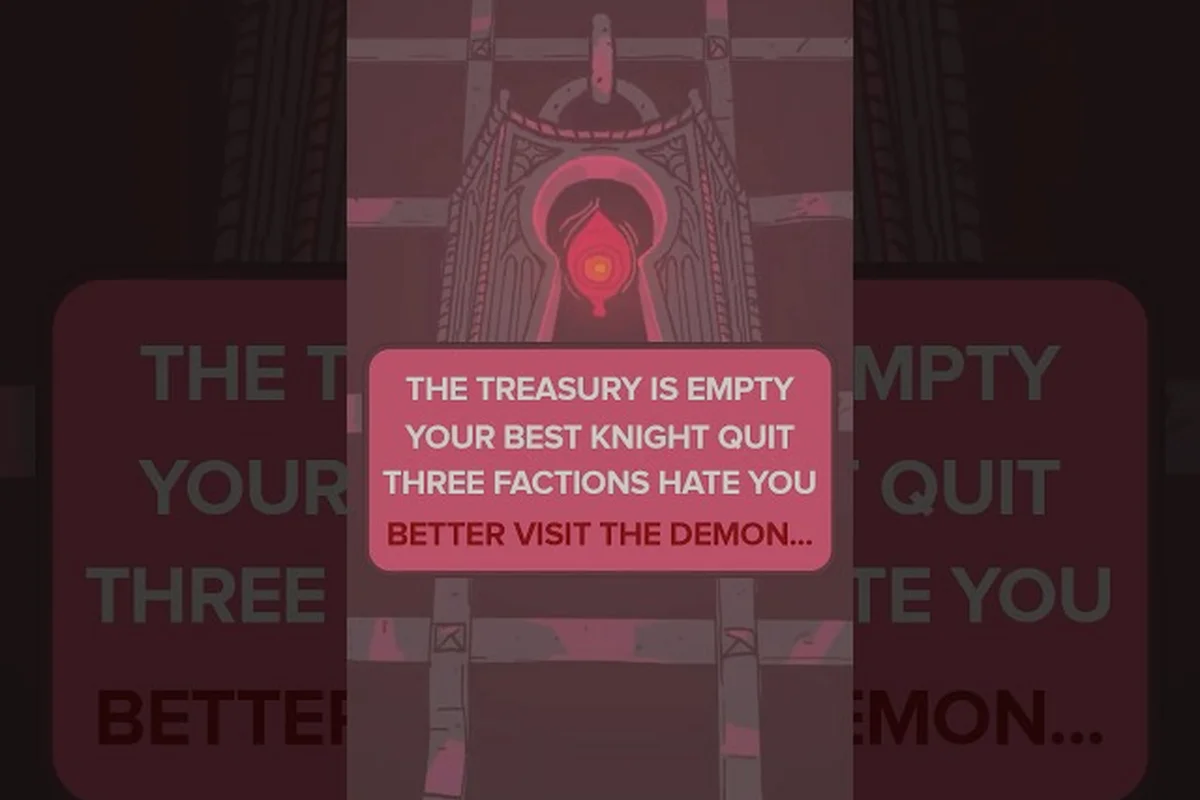
The sovereign tower demon deal is the most consequential choice you will make in WILD WITS GAMES' Arthurian management RPG, because it trades an entire timeline for retained memories and unlocks the Omniscience attribute. Every player eventually faces this crossroads, whether they stumble into the sovereign tower crypts during a routine expedition or trigger it through a failed court judgment, and understanding the full cost before you sign matters more than any other decision in the game.
Contract Terms: What the Demon Actually Grants You
The sovereign tower demon deal appears when your Sovereign fails a critical check or when you deliberately seek out the entity sealed beneath the tower's foundations. According to IGN's hands-on preview, accepting the deal means trading a timeline for retained memories, which sounds generous until you realize what you are actually surrendering. The Demon does not take gold, influence, or even your knights—it takes the entire history of your current run and replaces it with a fresh branch where only your memories persist.
This mechanic sits at the heart of the game's time-rewind system, which PC Gamer called "one of the best time travel systems" they have encountered in a management RPG. The brilliance lies in how the deal interacts with everything else you have built:
-
Your tower's physical state resets to the moment you accepted the deal, including all construction, upgrades, and decorations.
-
Knight relationships revert to their pre-deal status, which means oaths, rivalries, and romances you cultivated vanish.
-
Court decisions from the erased timeline never happened, so factions that hated you may now be neutral or even friendly.
-
Inventory and resources return to their starting values at the deal point, though you keep any memory-locked items you unlocked through previous deals.
The Demon frames this as a gift because you retain strategic knowledge about what went wrong, but the game's own description makes the catch explicit: everything good that happened in the erased timeline is gone. If you spent twelve hours building a prosperous realm and then made one catastrophic mistake, the deal rewinds you past that mistake—but it also erases the prosperity.
Where the Deal Originates
The sovereign tower demon resides in the deepest chamber of the crypts, accessible only after you have either lost a knight to the armor-death mechanic or discovered the hidden passage during a routine maintenance expedition. Community reports suggest the entity appears more frequently when your Nobility approval drops below 20 percent, as if it feeds on desperation.
What You Keep vs. What You Lose in a Demon Deal
The sovereign tower demon deal uses a surprisingly generous memory system, and knowing exactly what carries over determines whether you should accept or decline. Based on community testing and the official Steam description, the deal preserves your strategic awareness while stripping your tangible progress.
| Kept After Deal | Lost After Deal | Conditional |
|---|---|---|
| Omniscience attribute | All tower construction | Knight equipment (if not memory-locked) |
| Unlocked dialogue options | Court relationships | Faction standing (resets to neutral) |
| Knowledge of future events | Inventory items | Royal treasury (partial retention) |
| Memory-locked artifacts | Completed quests | Unlocked recipes (relearnable) |
The Omniscience attribute deserves special attention because it functions as a permanent meta-progression that survives every deal. Each time you accept the bargain, the attribute increases by one point, and higher values unlock precognitive dialogue options that let you warn knights about dangers they have not yet encountered. Players who chain multiple deals report that Omniscience at rank three or higher fundamentally changes how court sessions play out.
The Memory-Lock System
Certain items and achievements become memory-locked when you acquire them, which means the Demon cannot take them. The game communicates this through a subtle golden aura around locked items in your inventory, and the system exists specifically to reward players who pursue optional content before triggering the deal.
How the Omniscience Attribute Works
When you accept the sovereign tower demon deal, the Omniscience attribute becomes your primary compensation for losing everything else. The attribute operates on a rank system that scales with how many timelines you have sacrificed, and each rank provides tangible mechanical benefits that reshape your approach to the game.
| Omniscience Rank | Unlocked Effect | Requirement |
|---|---|---|
| Rank 1 | See one future event per court session | Accept first deal |
| Rank 2 | Warn a knight about fatal danger once per season | Accept second deal |
| Rank 3 | Unlock hidden dialogue with the Demon | Accept third deal |
| Rank 4 | Preview faction reactions before voting | Accept fourth deal |
| Rank 5 | Rewind a single decision without full reset | Accept fifth deal |
The Rank 5 ability is arguably the most powerful tool in the entire game because it grants a mini-rewind that does not require sacrificing your timeline. According to player reports, this ability has a long cooldown of roughly three in-game seasons, but it effectively gives you a safety net for catastrophic mistakes without triggering the full deal sequence.
Strategic Use of Omniscience Gained From Deals Gained From Deals
Veteran players recommend banking at least two Omniscience ranks before attempting the game's hardest content, particularly the Crimson Court events that require precise faction management. The precognitive dialogue options at Rank 2 can prevent knight deaths, which matters because armor-death is permanent and cannot be undone through conventional resurrection mechanics — our round table guide covers the quest-assignment habits that keep knights out of harm's way in the first place.
Deciding Whether to Rewind After a Knight Dies
Timing the sovereign tower demon deal correctly separates successful runs from abandoned ones, because accepting at the wrong moment can erase hours of careful preparation. The game gives you no explicit warning about what you are sacrificing, so you must evaluate your current situation against the potential benefits.
Accept the deal when:
-
You made an irreversible mistake within the last hour of play, such as executing an innocent knight or triggering a faction war.
-
Your tower is in ruins from an invasion or plague, and rebuilding from the deal point costs less than recovering.
-
You are chasing Omniscience ranks deliberately, treating the deal as a progression mechanic rather than an emergency escape.
-
Your court composition has become unmanageable, and you want to reset relationships to a more favorable starting point.
Decline the deal when:
-
You have invested significant time in current knight relationships, especially if you are close to unlocking a special oath or marriage event.
-
Your faction standing is excellent across all four groups—Nobility, People, Merchants, and Scholars—because the reset will erase that goodwill.
-
You are mid-quest with a time-sensitive objective, as the deal resets quest progress and may cause you to miss exclusive rewards.
-
Your Omniscience rank is already high enough for your current goals, and the marginal benefit of another rank does not justify the cost.
The sovereign tower crypts location matters for timing as well, because reaching the Demon requires a full expedition that consumes resources and knight availability. If your best knights are injured or your treasury is low, the journey itself may weaken you further before you even make the choice.
Risk Assessment Framework
Before accepting, run a quick mental checklist: Can I recover from this mistake without a reset? If the answer is yes, decline the deal. If the answer is no, accept it and treat the lost progress as tuition for learning the game's systems. Players who accept deals impulsively often regret them, while those who treat the Demon as a strategic resource rather than a panic button tend to build stronger long-term runs.
Comparing the Demon Deal to Other Rewind Options
The sovereign tower demon deal is not the only time-rewind mechanic in the game, and understanding how it compares to alternatives helps you make better decisions. The game offers several ways to undo mistakes, each with different costs and limitations.
| Rewind Method | Cost | What You Keep | Best Used For |
|---|---|---|---|
| Demon Deal | Entire timeline | Memories, Omniscience | Major resets, meta-progression |
| Standard Rewind | One season of resources | All progress | Minor mistakes, combat retries |
| Memory Fragment | Rare consumable | Current timeline | Single decision reversal |
| Knight Sacrifice | One knight's life | All progress | Preventing catastrophic events |
The standard rewind is the most accessible option because it costs only resources, but it only rewinds a short window and cannot undo major structural changes — our rewind guide walks through each recovery option step by step so you know exactly when a full timeline reset beats a targeted fix. The memory fragment is rarer but more precise, letting you undo a single decision without losing anything else. The knight sacrifice is the darkest option, requiring you to permanently lose a knight to prevent a worse outcome.
According to community data, most players use the demon deal as a last resort rather than a primary strategy, because the Omniscience attribute's benefits compound slowly while the costs are immediate. However, players who embrace the deal as their main progression loop report that high-rank Omniscience transforms the game into something almost prophetic, where you can guide your faction through crises before they even begin.
Crypts Lore Every Demon Deal Player Should Know
The sovereign tower crypts serve as the physical gateway to the Demon, and exploring them thoroughly before making your decision reveals important context. Hidden scrolls in the crypts hint at the Demon's true nature, and players who read all the lore entries report that the deal's framing becomes more sinister—the Demon may not be offering a gift but rather collecting something it needs from your discarded timelines.
Practical Tips for Maximizing the Deal
Making the sovereign tower demon deal work in your favor requires preparation before you ever descend into the crypts. Players who walk in unprepared often waste the opportunity, while those who plan ahead extract maximum value from the reset. The most common mistake players make with the sovereign tower demon deal is accepting it without a clear goal.
Before accepting the deal:
-
Spend down your treasury on permanent upgrades that might carry over, such as memory-locked artifacts or faction gifts that persist through the reset.
-
Complete any time-sensitive quests you care about, because the deal erases quest progress and you may not get another chance at exclusive rewards.
-
Save screenshots or notes about your current faction standings, knight relationships, and court decisions—this information helps you plan your post-deal strategy.
-
Equip your best knights with memory-locked gear, since equipment that survives the reset gives you a head start in the new timeline.
After accepting the deal:
-
Prioritize rebuilding your tower's core infrastructure before expanding into luxury amenities, because your Omniscience knowledge lets you avoid the mistakes that ruined your previous run.
-
Use your precognitive dialogue options to warn knights about dangers they have not yet encountered, which builds trust faster than conventional relationship-building.
-
Revisit the crypts to see if the Demon offers additional dialogue at your new Omniscience rank—some players report hidden quests unlock only at higher ranks.
The sovereign tower demon also responds to how you treat other characters in the game, and players who maintain high Scholars faction standing report that the Demon offers slightly better terms. This may be a flavor detail rather than a mechanical difference, but community testing suggests the entity respects knowledge-seekers.
Common Mistakes to Avoid
The most common mistake players make with the sovereign tower demon deal is accepting it without a clear goal. If you do not know what you want from the reset, you will likely repeat the same mistakes in the new timeline and end up back at the crypts within a few hours. Set a specific objective before accepting—whether that is reaching a certain Omniscience rank, avoiding a specific disaster, or testing a new faction strategy—and use the reset as a tool to achieve that objective.
Frequently Asked Questions
What happens if I decline the sovereign tower demon deal?
Declining simply closes the dialogue and returns you to the crypts, with no penalty or reward. You can revisit the Demon later, and the deal offer will reappear under the same conditions. Some players report that declining multiple times triggers unique dialogue where the Demon questions your motives, but this does not affect gameplay mechanics.
Can I accept the sovereign tower demon deal more than once?
Yes, you can accept the deal as many times as you want, and each acceptance increases your Omniscience attribute by one rank. However, the cost of losing your timeline grows heavier with each deal because you have more progress to lose. Players who chain multiple deals often do so deliberately to reach high Omniscience ranks quickly.
Does the sovereign tower demon deal affect my achievements or trophies?
Achievements tied to specific timeline events may become unobtainable if you reset past them, but meta-achievements that track cumulative progress remain intact. The game distinguishes between timeline-specific achievements and meta achievements, and the deal only affects the former. Check your achievement list before accepting if you are hunting for a specific trophy.
How do I find the sovereign tower demon in the crypts?
The Demon resides in the deepest chamber of the sovereign tower crypts, accessible after you trigger the deal event through a failed critical check or by discovering the hidden passage. The passage typically appears after you lose a knight to the armor-death mechanic, though some players report finding it through exploration alone.
What is the best Omniscience rank to aim for?
Most players consider Rank 3 the sweet spot because it unlocks hidden dialogue with the Demon, which provides additional lore and sometimes reveals useful information about upcoming events. Rank 5 is powerful but requires sacrificing five timelines, which most players find excessive. Aim for Rank 3 on your first playthrough and decide later if you want to push higher.