
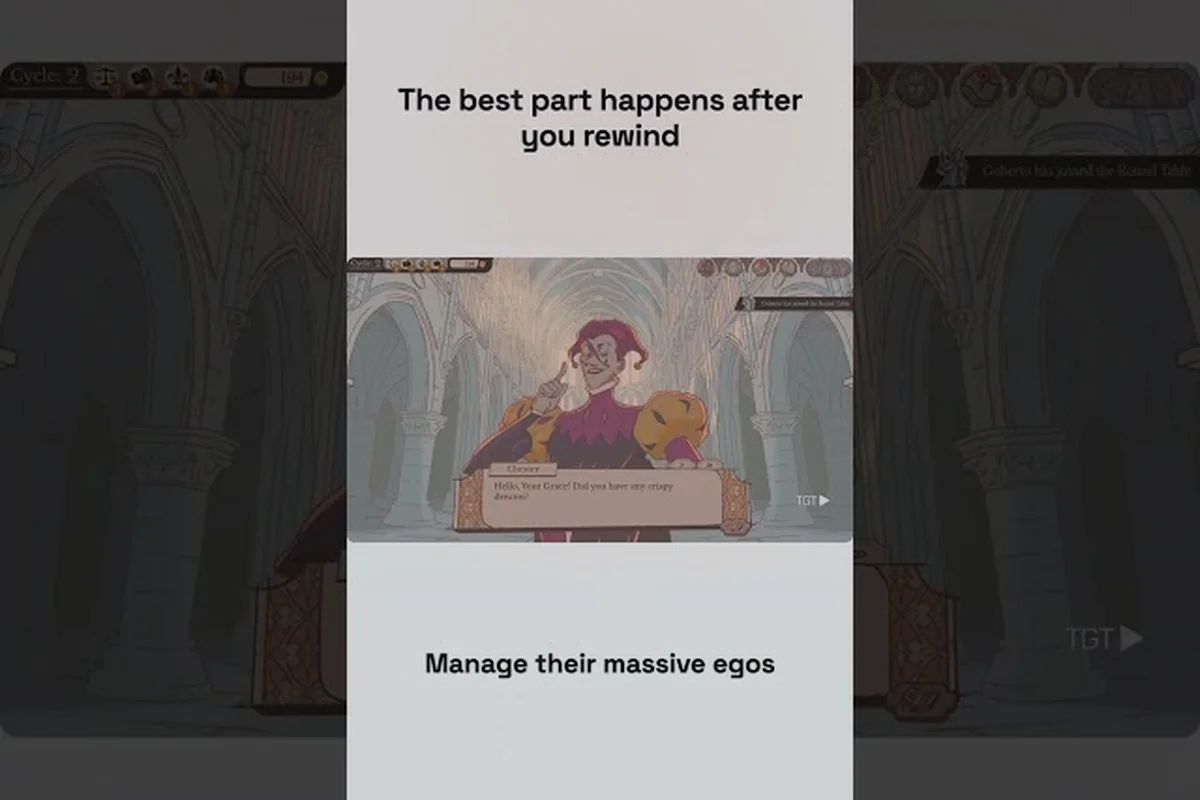
When a beloved knight falls in battle or a faction collapses into open revolt, most management games force you to live with the consequences. Sovereign Tower does not. The sovereign tower how to rewind time system lets you erase the current timeline entirely, keeping only your Sovereign's memories as a bridge to a second chance. Here is exactly how it works, where to find the trigger, and when the cost is worth paying.
The Sovereign Tower Rewind Time Trigger: Reaching the Demon in the Crypts
The path to temporal reset runs through the Sovereign Tower crypts, the sunken chambers beneath your fortress where the Demon of the Crypts makes its lair. This entity is not a boss you fight; it is a patron you negotiate with, and it only appears after a significant disaster or a moment of deep regret. According to the official Sovereign Tower page on Steam, the trigger condition is tied to accepting the erasure of the current timeline while preserving your Sovereign's accumulated knowledge.
The crypts unlock early in a run, but the Demon's dialogue prompt only activates under specific circumstances. Community reports from the Sovereign Tower itch.io devlog suggest the game tracks a "regret threshold" behind the scenes, which rises when you lose a knight to the armor-death mechanic or watch a faction's affinity plummet below critical levels.
Step-by-Step Activation Sequence
The process follows a consistent pattern across playthroughs, though the timing shifts based on your choices: Based on community testing and aggregated player experience, here is a practical framework for evaluating whether the erasure is worth the cost. Once you understand the basic sovereign tower how to rewind time flow, you can start optimizing for specific outcomes across multiple cycles.
-
Reach the crypts by progressing through the tower's lower levels until the Demon's door appears on your map.
-
Suffer a major loss — a knight death, a faction collapse, or a failed quest chain that cascades into a worse outcome.
-
Return to the crypts within the same cycle. The Demon will be waiting with a proposal.
-
Accept the erasure of the current timeline. This is a one-way door; you cannot cancel mid-transition.
-
Retain your Sovereign's memories of everything that happened, which unlocks new dialogue options and strategic knowledge for the next cycle.
The key distinction here is that the Sovereign Tower demon does not send you back to a checkpoint. The rewind has two defining effects: That is the entire foundation of the Sovereign Tower time rewind loop. That is the entire foundation of the Sovereign Tower time rewind loop.
-
Erases the timeline — starts a fresh run
-
Keeps your memories intact — retained knowledge carries over That is the entire foundation of the Sovereign Tower time rewind loop.
What You Keep vs. What You Lose When Erasing the Timeline Fully
Understanding the exact exchange is critical because many players assume the rewind is a simple save-scum tool. It is not. The Sovereign Tower rewind guide community has documented a clear split between persistent knowledge and lost resources, which I have summarized below.
| Category | What Survives the Rewind | What Is Erased Completely |
|---|---|---|
| Sovereign Knowledge | Memories of quest outcomes, faction reactions, and hidden dialogue triggers | Physical items, gold, and crafted equipment |
| Omniscience Attribute | Retained knowledge converts into Omniscience points at the start of the next run | Any unspent Omniscience from the previous cycle |
| Knight Relationships | Emotional memory of bonds, which can alter first-meeting dialogue | Current loyalty values and equipped armor |
| Annex Progress | Blueprint familiarity for faster construction decisions | All built structures and upgraded forges |
| Faction Standing | Awareness of faction preferences and past grievances | Current affinity scores and court positions |
The Omniscience attribute deserves special attention because it is the only mechanical currency that persists. Each cycle, your retained memories convert into points that unlock permanent bonuses, such as increased audience approval gains or reduced knight training times. The IGN hands-on preview highlighted this as one of the most innovative systems in the game, noting that it transforms failure into a strategic resource rather than a dead end.
The Armor Score Interaction That Forces Rewinds
One of the most common reasons players seek the Sovereign Tower demon is the permanent death system. When a knight's armor breaks in combat, that knight dies permanently. There is no resurrection mechanic, no hidden revive quest — only the rewind. This creates a brutal tension: do you accept the loss and continue with a weakened roster, or do you erase the timeline and lose all your physical progress to save that knight?
Player experience across the community suggests that rewinding for a single knight death is often the right call in the early game, because knights carry unique archetypes that cannot be replaced. Losing your only tank or your primary healer can cascade into a death spiral that makes the run unwinnable. However, in the late game, when you have a deep roster of trained replacements, the cost of losing your annexes and treasury often outweighs the value of one knight.
How Omniscience Reshapes Your Next Cycle
The Sovereign Tower omniscience system is what separates this game from standard roguelike repetition. When you rewind, you do not just start over with better knowledge; you start over with mechanical advantages that scale with how much you learned. That is the entire foundation of the Sovereign Tower time rewind loop.
| Omniscience Level | Bonus Unlocked | Best Used For |
|---|---|---|
| 1-3 points | +5% audience approval on first court session | Smoothing early faction relations |
| 4-7 points | Unlock hidden dialogue options with the Lady of the Tower | Romance routes and secret quest chains |
| 8-12 points | Reduced training time for new knights | Rebuilding a roster faster after a roster wipe |
| 13+ points | Access to exclusive Demon dialogue about future events | Predicting and preventing disasters before they occur |
The higher your Omniscience, the more the game acknowledges your previous failures. At 13+ points, the Demon begins offering cryptic warnings about upcoming events, which effectively turns the rewind system into a precognition tool. Players who master this loop report that their third or fourth cycle becomes significantly easier because they can preemptively address the faction tensions that destroyed their first run.
Strategic Use of Retained Knowledge Before Rewinding Before Rewinding
The real power of the rewind is not the Omniscience points themselves but the conversational knowledge you carry. When you meet a knight who betrayed you in the previous timeline, you now know their tells. When a faction leader makes a demand that led to a collapse, you can spot the trap before you fall into it.
According to the PC Gamer review, the game's time travel system is "one of the best encountered" in the genre precisely because it makes knowledge a tangible resource. The review notes that the game feels ruthless and full of impossible choices, but the rewind mechanic transforms those impossible choices into learning opportunities.
For a deeper dive into how the time travel mechanic interacts with the broader game systems, check out our Sovereign Tower time travel mechanic breakdown, which covers the technical implementation and edge cases. That is the entire foundation of the Sovereign Tower time rewind loop.
Erasure Decisions: Weighing Knight Lives Against Progress
Not every disaster warrants a full timeline reset. The sovereign tower how to rewind time decision should be made deliberately, not reflexively. Based on community testing and aggregated player experience, here is a practical framework for evaluating whether the erasure is worth the cost.
| Situation | Time Rewind Worth It? | Reason |
|---|---|---|
| Knight death in early game (first 3 seasons) | Yes | Roster depth is too shallow to absorb the loss |
| Faction collapse below 20 affinity | Yes | The cascade effect will cripple court audiences for seasons |
| Single quest failure with no cascade | No | The cost of losing annexes outweighs one failed quest |
| Knight death in late game (season 8+) | Usually no | Trained replacements exist; the treasury loss is too severe |
| Missed romance trigger | Yes | Romance routes are tied to specific dialogue windows that may not reappear |
The most common mistake new players make is treating the rewind as a free retry button. It is not free — you surrender every physical asset you have built. The Sovereign Tower demon does not care about your forged weapons or your upgraded alchemy room; those are erased without compensation. The only thing that matters is what you learned.
The Faction Collapse Scenario in Detail
Consider the faction collapse scenario, which is the single most frequent reason players seek the Sovereign Tower crypts. When the Nobility faction drops below 20 affinity, they begin withholding tax revenue, which starves your treasury, which prevents you from paying knights, which triggers loyalty drops, which causes more deaths.
This cascade can spiral out of control within two seasons. Rewinding at the first sign of collapse — when the Nobility hits around 30 affinity — allows you to replay the last few seasons with full knowledge of which audience decisions triggered the decline. The retained memories let you pivot your court responses before the cascade begins.
For a complete overview of how the rewind fits into the broader time travel systems, the Sovereign Tower time rewind guide offers a comprehensive walkthrough of all temporal mechanics. The Sovereign Tower rewind guide community has documented a clear split between persistent knowledge and lost resources, which I have summarized below.
Advanced Rewind Tactics for Multiple Playthroughs and Endings
Once you understand the basic sovereign tower how to rewind time flow, you can start optimizing for specific outcomes across multiple cycles. The game rewards players who treat each run as a learning opportunity rather than a fresh start. That is the entire foundation of the Sovereign Tower time rewind loop.
The Two-Cycle Romance Strategy
Romance routes in Sovereign Tower are notoriously finicky, with heart events triggering only during specific dialogue windows. If you miss a trigger, it may not reappear for several seasons. The rewind system allows a targeted approach: Once you understand the basic sovereign tower how to rewind time flow, you can start optimizing for specific outcomes across multiple cycles.
-
Cycle 1: Focus on building affinity with your chosen romance option while documenting exactly which dialogue choices produce positive reactions.
-
Cycle 2: Use your retained knowledge to hit every heart event trigger perfectly, skipping the trial-and-error phase entirely.
-
Cycle 3: With Omniscience points accumulated, unlock the hidden dialogue options that lead to the forbidden romance paths with the Lady of the Tower.
This approach requires sacrificing the physical progress of two runs, but the payoff is a romance route that many players never see because they lack the Omniscience threshold. The Demon in the Crypts guide covers the specific dialogue requirements for these advanced paths.
The Knowledge Stacking Approach
Veteran players report that the most efficient way to use the rewind is to stack knowledge across cycles without fully completing any single run. The idea is to intentionally trigger disasters in specific areas — such as letting the Merchant faction collapse — so that you learn their failure patterns in detail. Then rewind and apply that knowledge to prevent the collapse in the next cycle.
This sounds counterintuitive, but it works because the Omniscience attribute rewards depth of understanding, not just breadth. A player who has seen the Merchant faction collapse three times understands their triggers far better than a player who has merely read a guide. The Demon's dialogue at high Omniscience levels even begins referencing your past failures directly, which adds a narrative layer to the mechanical advantage.
Frequently Asked Questions
How do I unlock the ability to rewind time in Sovereign Tower?
The rewind ability unlocks automatically when you first access the Sovereign Tower crypts and suffer a significant loss. The Demon of the Crypts will appear with the erasure proposal after a knight dies, a faction collapses, or a major quest chain fails. You do not need to unlock it through a separate quest; the trigger is purely loss-based.
Does the Sovereign Tower demon appear every time I lose a knight?
No, the Demon does not appear automatically after every death. The appearance is tied to a regret threshold that rises with significant losses. Minor setbacks like a single failed quest may not trigger the encounter. However, returning to the crypts after any major disaster will usually activate the dialogue prompt.
What exactly does Omniscience do in Sovereign Tower?
Omniscience is the persistent currency that survives the timeline erasure. Each retained memory converts into Omniscience points, which unlock permanent bonuses like increased audience approval, hidden dialogue options, and reduced training times. At high levels, the Demon provides cryptic warnings about future events, effectively giving you precognition.
Can I rewind time multiple times in a single playthrough?
Yes, the rewind is not a one-time ability. You can visit the Demon in the Crypts multiple times across a run, provided you trigger the regret threshold each time. However, each erasure resets your physical progress, so repeated rewinds can leave you perpetually stuck in the early game if you rely on them too heavily.
Is there any way to keep my annexes when I rewind?
No, all physical structures are erased when you accept the timeline erasure. The only things that persist are your Sovereign's memories, which convert into Omniscience points. This is the core trade-off of the system: you sacrifice tangible progress for intangible knowledge that makes the next run more efficient.